The Silent Architecture: How the Latest Tech Leaks Are Quietly Preparing for AI's Next Leap
Today’s tech headlines might appear to focus on incremental hardware and operating system updates, but a closer look reveals a deeper trend. Behind the scenes, the plumbing of the consumer tech ecosystem is being quietly rebuilt to support the heavy computational demands of our AI-driven future.

Microsoft’s announcement regarding Windows 11 version 26H2 serves as a prime example of this infrastructure-first approach. Rather than forcing users through a disruptive, ground-up operating system installation, Microsoft is preparing a streamlined enablement package to transition users from older builds. While this might look like simple system maintenance, maintaining a highly efficient, frictionless update pipeline is critical for Microsoft’s broader AI strategy. With local Neural Processing Units (NPUs) becoming standard in modern PCs, the operating system must continuously optimize how it handles local machine learning models and cloud-based Copilot tasks without degrading the user experience.
The AI Divide: Apple’s Subtle Utility vs. Microsoft’s All-In Gamble
Today’s AI landscape is defined by two wildly different philosophical approaches from the world’s biggest tech giants. On one hand, Apple is quietly weaving AI into the background of its hardware ecosystem, refining user experience through practical utilities and a freshly polished, surprisingly capable Siri. On the other hand, Microsoft is aggressively pushing AI into every nook and cranny of its software, a move that is drawing sharp criticism for prioritizing hype over the stability of its most trusted products.
From Miraculous Speech to Accidental Luxury: How AI is Redefining Our World
Today’s AI headlines show a technology that is no longer confined to the abstract space of software. Instead, artificial intelligence is actively rewriting the rules of our physical reality. From a medical breakthrough that restores human connection to the subtle ways algorithms are squeezing the global hardware supply chain and cataloging our digital footprints, AI is asserting itself in every corner of our lives.

The Quiet Realities of the AI Boom: From Smart Assistants to Hardware Hurdles

Today’s artificial intelligence landscape is caught in a fascinating tension. On one hand, we are seeing the technology mature into genuinely useful, everyday tools that live on our phones and in our creative applications. On the other hand, the sheer scale of the AI boom is starting to strain global supply chains and ignite a quiet backlash from industry veterans and privacy advocates alike.
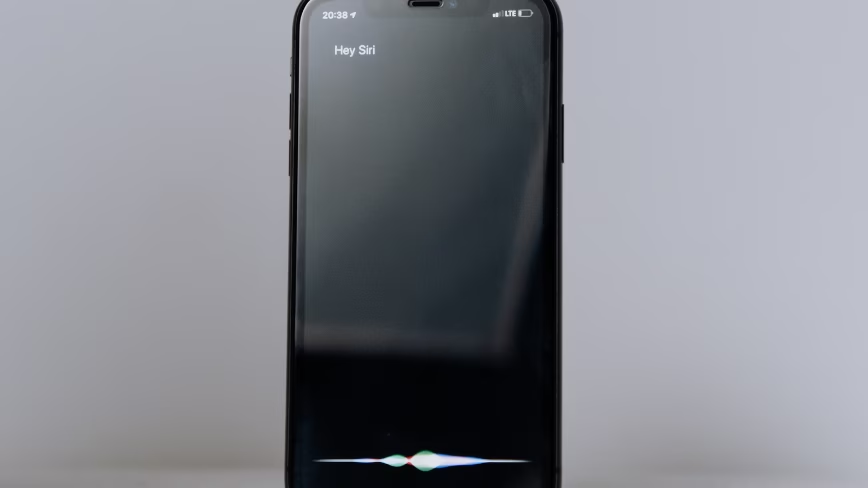
We can start with how AI is finally beginning to feel practical on our personal devices. For years, voice assistants have felt like glorified egg timers, but Apple’s latest push into conversational AI might finally change that. Tech journalist Joanna Stern recently spent a week putting the new Siri AI through its paces on iOS 27. According to a review covered by 9to5Mac, the upgraded assistant is proving to be genuinely useful, showing substantial improvements in handling complex contextual queries and behaving more like an intuitive partner than a rigid command line.
The Invisible Infrastructure: How AI is Quietly Rewriting the Rules of Our Digital Lives
Today’s artificial intelligence landscape is shifting from flashy, stand-alone demonstrations to a quiet, deep integration into the tools we use every single day. From the operating systems on our phones to the creative software on our laptops and the underlying engines powering our video games, tech giants are aggressively embedding AI into the background. Yet, as this corporate push accelerates, we are seeing a growing friction—both from independent creators worried about the future of their art and from researchers warning us not to confuse sophisticated software with actual consciousness.
The New Boundaries of AI: From Ambient Hardware to Creative Friction
Today’s AI headlines mark a distinct shift in how artificial intelligence is moving out of the browser and into the physical and creative spaces we inhabit daily. From Apple’s quiet hardware ambitions to Google’s re-engineering of the smart home, the technology is becoming structural plumbing. Yet, as developers and creators grapple with the rapid pace of automation, we are seeing the first real signs of cultural and security pushback.

The AI Integration Era: From Siri's Long Journey to Steam's Creative Crisis
Today’s AI landscape is marked by two distinct undercurrents: the slow, deliberate work of tech giants trying to refine AI for daily utility, and the chaotic, unregulated flood of synthetic content that threatens to drown out human creativity in the indie gaming scene. From Apple finally explaining its long road to a smarter Siri to Adobe’s relentless integration of creative tools, the technology is cementing itself in our workflows—even as its cultural footprint remains highly contested.
Behind the Screens: Apple’s Stealth AI Strategy and the Frontiers of AI-Generated Gaming
Today’s AI landscape highlights a fascinating contrast between corporate caution and wild, experimental ambition. While major tech giants carefully manage their public narratives to navigate legal and regulatory minefields, individual developers are pushing consumer AI models to their absolute limits. Together, these developments suggest a future where artificial intelligence is increasingly modular, highly personalized, and capable of turning raw human intent into functional software.
From Screenless Wearables to Military Drones: AI’s Quiet Invasion of the Everyday
Today’s AI landscape is no longer just about giant data centers and conceptual tech demos; it is rapidly morphing into an intimate, background presence in our daily lives. From the updates quietly landing on our smartphones and laptops to screen-free fitness trackers and the unexpected repurposing of game data for defense tech, the boundaries of where AI starts and ends are blurring faster than ever.

We can start on our desktops, where Apple is finally making its move. Following its big announcements, the initial hands-on reviews of the new Siri AI on the Mac are trickling in. As reported by The Verge based on the macOS 27 Golden Gate developer beta, the upgraded assistant is undoubtedly smarter and more context-aware, but its limitations remain starkly visible when trying to navigate complex desktop workflows compared to simpler mobile tasks. Nevertheless, this marks the beginning of a massive paradigm shift. CNN notes that Wall Street has been eagerly awaiting this revamp to revitalize Apple’s ecosystem, yet the real challenge lies in whether the average consumer will actually embrace these deeply integrated features as essential daily tools or dismiss them as tech-industry hype.
Siri’s New Limits, Gaming’s Ghost Assets, and the Unexpected Military Uses of Pokémon Go
Today’s AI landscape reveals a striking contrast: on one hand, we are getting smarter, more intimate software on our personal devices; on the other, the quiet, massive infrastructure of AI training is repurposing our daily digital lives in ways we never explicitly consented to. From Apple’s hardware-bound Siri upgrades to gamers unwittingly feeding military drone algorithms, today’s news highlights how deeply AI is weaving itself into both our private and public spheres.